
The Soul of a House: Why Your Home’s Exterior Is More Than Just a Shell
Imagine walking down a quiet suburban street at dusk. Most houses blur into a predictable rhythm of beige siding and standard red brick. But then, you see it—a structure that stops you in your tracks. It doesn’t just occupy space; it commands it. The walls seem to have a texture that catches the fading sunlight, a mix of deep charred wood and sleek, rusted steel that looks more like a piece of art than a residential building. This is the power of custom exterior materials.
SUBMIT YOUR DETAILS FOR
For decades, home design was dictated by what was available at the local hardware store. We were limited by the “safe” choices. But today, the modern homeowner views their house as an extension of their identity. Building a modern home is no longer just about floor plans and interior decor; it’s about the “skin” of the building. Choosing custom exterior materials is the ultimate storytelling tool in architecture. It tells the world who you are, how you value sustainability, and how you perceive the relationship between your private sanctuary and the outside world.
In this guide, we are going to explore the materials that are redefining modern architecture. We’ll move beyond the basics and dive into the textures, colors, and technologies that can turn a simple structure into a landmark.
The Charred Elegance: Shou Sugi Ban (Yakisugi)
There is something deeply poetic about using fire to protect wood. Shou Sugi Ban, an ancient Japanese technique of charring cedar, has seen a massive resurgence in modern custom homes. The process involves burning the surface of the wood to a charcoal state, then cooling it, cleaning it, and finishing it with natural oils.
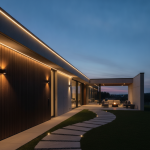
From a storytelling perspective, Shou Sugi Ban represents resilience. By intentionally damaging the surface, you make the wood more durable. The carbon layer created by the fire acts as a natural shield against insects, rot, and even fire itself. In terms of aesthetics, the deep, obsidian black of the charred wood provides a dramatic contrast to glass and greenery. It’s a material that looks different at every hour of the day, shifting from a matte charcoal to a shimmering silver depending on the light.
Why it works for modern homes:
- Texture: It adds a tactile, organic quality that breaks up the sharp lines of modern design.
- Low Maintenance: Once treated, it can last for decades without needing to be repainted or stained.
- Sustainability: It’s a natural product that uses ancient methods rather than harsh chemical sealants.
Industrial Poetry: Corten Steel and Modern Metal Panels
If you’ve ever seen a building that looks like it’s beautifully rusting, you’ve likely encountered Corten steel. Often referred to as “weathering steel,” this material is designed to eliminate the need for painting. After a few months of exposure to the elements, it develops a stable, rust-like appearance that actually protects the metal from further corrosion.
Using Corten steel is like owning a living painting. It starts as a dark grey metal and slowly transforms into a rich orange-brown, eventually settling into a deep, earthy purple-bronze. It tells a story of time and interaction with nature. In modern architecture, it’s often used as an accent material to highlight specific geometric volumes or to create a “rugged luxury” feel.
Beyond Corten, many architects are opting for custom-fabricated aluminum or zinc panels. These materials allow for razor-sharp edges and hidden fastening systems, creating a “monolithic” look where the house appears to be carved from a single block of metal.
The New Age of Stone: Large-Format Porcelain and Ultra-Compact Surfaces
For centuries, stone meant heavy blocks and thick mortar. But for the modern home, we are seeing a shift toward large-format porcelain slabs and ultra-compact surfaces like Dekton. These materials are engineered to be incredibly thin yet harder than granite.
Imagine a house where the exterior walls look like seamless sheets of white marble or raw concrete, but without the weight, porosity, or staining issues of the real thing. These custom surfaces allow architects to carry the same material from the interior flooring out onto the patio and up the exterior walls. This “blurring of the lines” is a hallmark of modern design, creating a sense of infinite space.
Key Benefits:
- UV Resistance: Unlike natural stone or wood, these surfaces won’t fade under the harsh sun.
- Thermal Efficiency: When used in a “ventilated facade” system, they provide incredible insulation, keeping the home cool in the summer and warm in the winter.
- Versatility: They can mimic almost any texture, from rusted metal to exotic wood grains.
Glass as a Structural Statement: High-Performance Glazing
In a modern home, glass isn’t just a window; it’s a wall. Custom exterior design often revolves around maximizing views and light while maintaining privacy. The modern trend is moving toward “switchable glass” or “smart glass” that can change from transparent to opaque at the touch of a button.
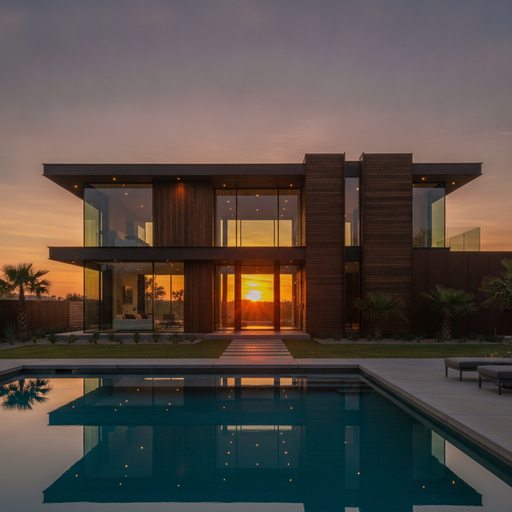
Furthermore, structural glass fins and corner-to-corner glass without visible frames are becoming the gold standard for luxury homes. By removing the visual weight of window frames, the house feels lighter and more integrated with the landscape. It allows the interior life of the home to become part of the exterior aesthetic, especially when paired with thoughtfully designed interior lighting.
The Warmth of Composite: High-Pressure Laminates (HPL)
Sometimes, the climate doesn’t allow for natural wood. If you live in an area with extreme humidity or salt spray from the ocean, maintaining real wood can be a nightmare. This is where High-Pressure Laminates (HPL) come in. These are custom-engineered panels made of wood fibers and resins, cured under immense heat and pressure.
Brands like Trespa or Fundermax offer panels that look indistinguishable from real wood but are essentially indestructible. They allow for a “rain-screen” installation, where the panels sit slightly away from the house’s structure, allowing air to circulate and moisture to escape. It’s a sophisticated, “cladded” look that feels warm and inviting but performs like a high-tech armor.
Bringing It All Together: The Art of Mixing Materials
The most successful modern homes rarely use just one material. The magic happens in the contrast. It’s the dialogue between the coldness of glass and the warmth of wood; the roughness of stone and the smoothness of metal.
When choosing your custom materials, think about the “Third Rule.” Choose one dominant material (usually a neutral like concrete or plaster), a secondary material for contrast (like dark metal), and a third “warm” material for accents (like wood or stone). This balance ensures that your home feels modern without feeling sterile, and unique without feeling chaotic.
Conclusion: Investing in Your Home’s Identity
Choosing custom exterior materials is an investment in the longevity and soul of your property. While standard materials might save a few dollars in the short term, custom solutions provide unparalleled durability, energy efficiency, and, most importantly, a sense of place. Your home is the backdrop of your life; it should reflect the story you want to tell.
Whether you choose the ancient, fire-hardened beauty of Shou Sugi Ban or the futuristic precision of large-format porcelain, remember that the exterior is the world’s first impression of your sanctuary. Make it count. Build something that doesn’t just stand there—build something that speaks.