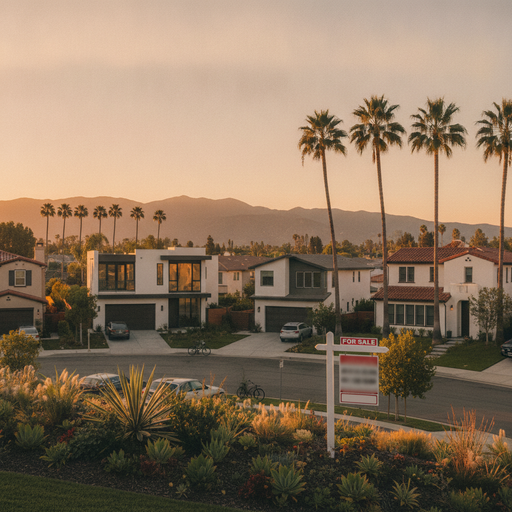

The California Dream at a Crossroads
Imagine standing on the Santa Monica Pier, the salt air on your face and the Pacific sun setting in a blaze of orange and purple. For many, this is the ultimate dream—owning a piece of the Golden State. But for Sarah, a tech professional in San Jose, and Mark, a teacher in Riverside, that dream has felt more like a marathon with no finish line in sight. They, like millions of others, have spent the last two years watching mortgage rates climb and inventory vanish, wondering if the California housing market will ever return to some semblance of “normal.”
SUBMIT YOUR DETAILS FOR
The story of California’s real estate is one of resilience, frustration, and constant evolution. As we look toward the horizon of 2024 and 2025, the forecast isn’t a simple “up or down” projection. It is a complex narrative shaped by stubborn inflation, a shortage of homes, and the changing ways we live and work. If you are looking to buy, sell, or simply understand what’s happening in the nation’s most watched market, you need to look beyond the headlines.
The Mortgage Rate Pendulum: Waiting for the Swing
For the past eighteen months, the California housing market has been held captive by the Federal Reserve’s battle against inflation. We saw mortgage rates jump from historic lows to peaks that many haven’t seen in decades. This created what economists call the “lock-in effect.” Imagine you bought a home in 2020 with a 3% mortgage rate. Why would you sell it today only to buy a new home with a 7% rate? This reluctance has kept thousands of homes off the market.
However, the forecast for the coming year suggests a softening. While we may never see 3% again, experts are predicting a gradual decline toward the 6% range. For buyers like Sarah, even a 1% drop can mean saving hundreds of dollars every month, potentially turning a “no” from the bank into a “yes.” This downward trend in rates is expected to act as a release valve, slowly bringing more buyers—and crucially, more sellers—back into the fold.
The Inventory Drought: A Supply-Side Saga
The biggest challenge in California isn’t just the price; it’s the lack of options. In many neighborhoods from San Diego to Sacramento, “For Sale” signs are becoming as rare as a rainy day in July. California has chronically under-built for decades, and the current forecast suggests that supply will remain tight, though it is slowly improving.
Current data shows that while inventory is ticking up slightly compared to the record lows of late 2023, it is still far below pre-pandemic levels. This scarcity is the primary reason why home prices in California haven’t crashed despite high interest rates. When you have ten buyers fighting over one house, the price stays high. In 2025, we expect to see a modest 10-15% increase in active listings, but buyers should still be prepared for competitive bidding wars in desirable coastal areas.
Regional Deep Dives: A Tale of Three Californias
To understand the California housing forecast, you have to realize that California isn’t one market—it’s many. The experience of a buyer in the Bay Area is vastly different from one in the Central Valley.
1. The Tech Hubs (San Francisco and Silicon Valley)
After a period of cooling due to remote work shifts, the Bay Area is showing signs of a “vibe shift.” AI is the new gold rush, and it’s bringing wealth and demand back to San Francisco and San Jose. Prices here are expected to remain stable or see modest growth as the “return to office” mandates gain more traction.
2. Southern California (LA, Orange County, San Diego)
SoCal remains one of the most competitive markets in the world. Orange County and San Diego, in particular, are seeing prices hit new record highs. The demand for coastal living is decoupled from the broader economy, fueled by high-income earners and international investment. Expect these areas to lead the state in price appreciation over the next 18 months.
3. The Inland Empire and Central Valley
For years, these regions were the “escape hatch” for people priced out of the coast. However, as prices rose there too, the affordability gap has narrowed. We are now seeing a stabilization in markets like Riverside and Fresno. These areas will likely see the highest increase in inventory as new construction projects—finally—move toward completion.
The Impact of New Legislation: ADUs and Zoning Changes
California’s government is trying to build its way out of the crisis. New laws aimed at increasing density are finally starting to show results. The surge in Accessory Dwelling Units (ADUs), or “gray flats,” has been a game-changer. Homeowners are turning their backyards into rental income or housing for family members.
Furthermore, laws that allow for lot splitting and the conversion of commercial spaces into residential units are begiing to reshape the suburban landscape. While these changes won’t fix the housing shortage overnight, the forecast for 2025 includes a significant contribution from these “non-traditional” housing starts, offering more diverse options for renters and first-time buyers.
Strategies for Buyers: How to Win in 2025
If you are plaing to enter the market, the narrative of “waiting for a crash” might be a losing strategy. Most economists agree that a major price correction is unlikely due to the supply-demand imbalance. Instead, buyers should focus on:
- Getting Pre-Approved Early: In a fast-moving market, you need to be ready to pull the trigger the moment a home hits the MLS.
- Expanding Your Search: Look at “up-and-coming” neighborhoods that are adjacent to high-priced hubs.
- Considering Fixer-Uppers: With high labor costs, many buyers are avoiding homes that need work, creating an opening for those willing to put in some “sweat equity.”
- Exploring First-Time Buyer Programs: California offers several down-payment assistance programs that many residents overlook.
The Seller’s Dilemma: When is the Right Time?
For Mark, who is thinking of selling his home in Riverside to move closer to family, the question is about timing. If you sell now, you get a high price, but you face the same high prices as a buyer. The forecast suggests that late 2024 and early 2025 will be the “sweet spot” for sellers. As rates dip slightly, a flood of buyers will return, likely driving up sales volume and ensuring that well-maintained homes sell quickly.
Conclusion: The Resilience of the Golden State
The California housing market forecast is not for the faint of heart. It is a landscape defined by high stakes and high rewards. While the days of explosive, 20% year-over-year price growth may be behind us, the fundamental demand for California living remains unshakable.
As we move into 2025, expect a market that is more balanced than the chaos of 2021, but more active than the stagnation of 2023. Whether you are Sarah looking for her first condo or Mark looking to downsize, the key to success is patience, preparation, and a realistic understanding that in California, real estate is more than just an investment—it’s a long-term commitment to a unique way of life. The dream isn’t dead; it’s just evolving.